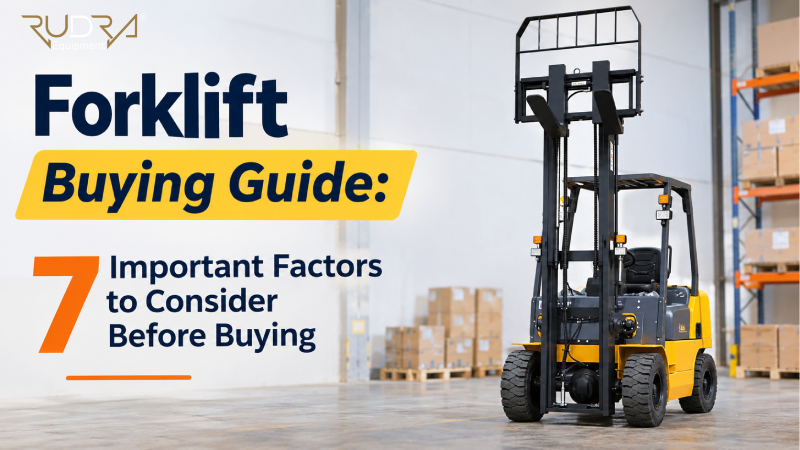
Buying a forklift without checking its lifting capacity, mast height, and operating requirements can create difficulties in daily material handling. How can warehouse managers select equipment that matches their actual workload? Rudra Equipment, a Forklift Manufacturer and supplier in India, offers electric forklift models for industrial lifting applications. Our team helps buyers evaluate available equipment according to their load and application requirements.
1. Evaluate Load Capacity and Lifting Height
Factor 1: Check the Maximum Load Capacity
The weight of materials being handled should be your first consideration when selecting a forklift. Choosing equipment without checking its rated capacity and load centre can create operational risks.
Our Electric Forklift range includes models with a rated lifting capacity of 3000 kg and a specified load centre of 500 mm. Buyers should calculate their maximum load weight and consider how load dimensions affect safe handling.
A forklift must be selected according to its rated operating limits, not simply the approximate weight of regularly transported goods.
Factor 2: Select the Required Lifting Height
Warehouse storage racks and loading arrangements determine how high a forklift needs to lift materials. Selecting the wrong mast height can restrict access to storage locations.
We offer electric forklift models with lifting heights of 3500 mm, 4500 mm, and 5500 mm. The 3500 mm model features a two-stage mast, while the 4500 mm and 5500 mm models feature three-stage masts.
Measure the highest required lifting point and check available overhead clearance before finalising your selection.
2. Examine Warehouse Space and Manoeuvrability
Factor 3: Measure Aisle Width and Turning Space
Restricted warehouse aisles can make material movement difficult when equipment dimensions are unsuitable. Buyers should measure aisle widths, entry points, and turning areas before selecting a Warehouse Forklift.
Our 5500 mm electric forklift has a specified width of 1110 mm and a length of 3660 mm including forks. Its technical specifications also include turning-radius measurements for assessing manoeuvrability.
These dimensions should be reviewed alongside pallet sizes, loading paths, and the space required for safe forklift operation.
3. Understand Battery Technology and Power Requirements
Factor 4: Review the Battery and Drive System
Battery performance affects how an electric forklift fits into daily warehouse operations. Consider operating hours, charging arrangements, and the equipment's electrical requirements before purchasing.
Our 5500 mm forklift features a 60V, 350Ah lithium battery and an electric drive system. Its specifications also identify a HaiQing controller and electric motors used for driving and hydraulic operation.
As a Forklift Manufacturer and supplier in India, we recommend discussing operating schedules and charging requirements with our team before choosing a particular model.
4. Assess Safety Features and Operating Controls
Factor 5: Examine Braking and Steering Arrangements
Forklift controls deserve careful attention when equipment will operate around storage racks, loading zones, and warehouse personnel. Buyers should review the braking system and steering arrangement for their intended application.
Our electric forklift models include hydraulic service brakes and mechanical parking brakes. The 3500 mm model also lists hydraulic steering, overload protection, and a backup alarm.
These features support equipment operation, but operator training and correct load handling remain necessary.
Factor 6: Check Tyres and Working Surface Conditions
Floor conditions affect forklift movement and equipment selection. Warehouses with uneven surfaces, slopes, or restricted pathways should assess their working environment before purchasing an Industrial Forklift.
Our electric forklift specifications include solid tyres, ground-clearance measurements, and gradeability ratings. The 5500 mm model lists 100 mm minimum ground clearance and solid tyres. Buyers should compare these specifications with actual floor conditions and planned movement routes.
5. Consider Maintenance and Long-Term Equipment Requirements
Factor 7: Review Maintenance and Service Needs
Regular maintenance supports dependable forklift operation and helps businesses plan equipment availability. Before purchasing, review access to important components and the maintenance requirements associated with the selected model.
Our electric forklift range includes hydraulic braking systems, electric drive components, and battery-powered operation. We also provide spare parts, repair support, and Annual Repair Agreements as part of our material handling equipment services. Discussing maintenance expectations with a Forklift Manufacturer and supplier in India helps buyers understand their equipment responsibilities before purchase.
Why Choose Rudra Equipment?
At Rudra Equipment, we offer practical material handling solutions for warehouses and industrial facilities. Based in Ahmedabad, Gujarat, our product range includes electric forklifts with different lifting heights and operating specifications. Our team helps customers compare equipment according to load capacity, available working space, and intended application, supporting informed forklift purchasing decisions.
Conclusion
Selecting the right forklift requires more than comparing lifting capacities. Buyers should examine mast height, warehouse dimensions, battery specifications, operating controls, floor conditions, and maintenance needs. Our electric forklift range offers different lifting configurations for warehouse and industrial material handling applications. Reviewing these seven factors before purchasing can help businesses choose equipment that matches their actual working requirements and supports organised daily material movement.
Planning to purchase an electric forklift? Contact Rudra Equipment to discuss your lifting needs and available models for your warehouse or industrial facility.
Call: +91 9925093683
Email: info@rudraequipment.in